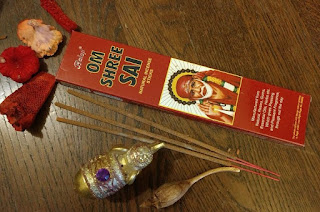
Flora and Fluxo are terms used in Indian incense, generally for
masala incense. The oldest use of these terms I am currently aware of is in the successful and popular (mostly in India)
Sri Sai Flora Fluxo Incense, which is quite oily, thick, and intense.
I took a look into Flora and Fluxo incense to understand these terms, and to see if there is any difference between when these terms are used, and if so what that difference is. As reported in my review of the Hari Om Fluxo, some Indian agarbathi makers seem to regard Fluxo as another term for masala incense, though perhaps fatter and richer - creating a rich, strong scent which will fill the room with the "flow" of the incense energy and scent. Incenses named Flora are normally also masala, though I've had some which were perfume-dipped, such as Moksh Swarna Sai Flora Batti. Most Flora is fat and rich, such as Balaji Red Premium Flora Sticks, though some, such as Sagon Sainath Flora Bathi, can be fairly dry and more like a standard masala. When looking back at my reviews of Flora and Fluxo incense I noticed that Supreme was also a term used for fatter and richer masala incense, such as Gokula Vrindavan Supreme, Happy Hari Meena Supreme, and Satya Supreme. On the whole I am tending to the thought that Flora, Fluxo and Supreme are terms generally used for fatter, richer masala incense, though as the terms are used just for marketing, as with the Moksh, they have no more significance than the word "premium", but in this case meaning "strong".
Some suggestions given to me by various Indian incense makers are that, while there is no defined definition or classification of "flora" and "fluxo" (and other terms such as "durbar", "supreme", "absolute", etc), and that each maker will use the terms as they see fit, a "flora" will tend to be a higher quality masala, or will contain more oils, or will simply be stronger (though at least one has said "softer and more refined"). Nobody has suggested that the term refers to floral, though I suspect that it links in with a common term in India for masala incense, and that is the term "natural" - as "flora" means plants, which is what a masala or natural incense was traditional mostly made from. The terms "natural" or "herbal" seem to me, based partly on anecdotal evidence of the incenses I have burned, partly on trawling through Indian incense company brochures and websites, and partly on the research I have done, to be more frequently used in India than "masala", which is more common in the West.
"Fluxo" means flow, and one incense maker has suggested that "fluxo" incense is more flexible, while a couple of others have connected it to Earth's energy, derived from plant life. "Fluxo" is not used as much as "flora", and when it is, it is mostly used in incense which is quite obviously copying
Sri Sai Flora Fluxo - the original "fluxo" and the original "flora" (as far as I've been able to discover - if there are earlier examples, please let me know!).
I'm becoming aware that most
luxury boxes contain "Flora" style incense, and that much "Flora" style incense is sold in luxury style boxes in India. There is a relationship. At least in India - when Flora style incense is packaged for a Western reseller such as Happy Hari, TOI, or Bhagwan, they use the same packaging as for the rest of their output.
When reviewing
Ramakrishna's Sunset I noted that the sticks were rough looking and tended to go out. Flora/fluxo/supreme styles can be like that. The flora
masala paste seems to be difficult to roll and dry in a tidy fashion. Some people have said that
halmaddi is a substance that attracts moisture, and so a flora stick is wet because of the halmaddi. Halmaddi does stay moist and pliable, which makes it easier to work with, but doesn't attract moisture any more than any other wood based material, and enough halmaddi was used to keep a stick moist the stick wouldn't burn. It's more likely to be the liquid scents that keep a flora/fluxo moist. The oils/perfumes and whatever else liquid that is added to the paste would likely make it wet and soft and heavy. I really don't know what liquids are added, but my assumption, given that floras are not proportionally more expensive than non-flora masalas, is that they are not pure essential oils. I'm not saying that they don't contain essential oils, but if all that fat dampness is the result of pure essential oils then floras would be massively expensive, and they are not, so the liquid content must come from some other less expensive source, which I suspect is mostly
agarbatti oil / DEP. DEP is a plasticiser, like halmaddi and like vanilla crystals (
which are always going to be synthetic), it is used to heighten and prolong the fragrance of the incense. Vanilla scent, for example,
has a half-life of 14 hours. Because of its intrusive nature, not many incense houses use vanilla, though, famously,
HMS do. Anyway, with a dump load of agarbatti oil in with the essential oil(s), a flora style incense is going to make a bigger impact than a non-flora masala. And we all know that floras are about the impact! Big and heady and sometimes overwhelming. Not subtle. Not delicate. Big juggernauts of Indian incense.
Flora/Fluxo type incenses are bold and full of character. There was a quirky and tongue-in-cheek ad campaign for the noodle snack
Pot Noodles which used the strapline "
The Slag of All Snacks", and that could be applied to Flora incense, as "The Slag of All Incense" as it is brash, crude, gaudy, colourful, loud, and exciting.
Slag is a British slang word which has various uses, generally as an insult or playful banter against both males and females to suggest they are not refined or well behaved, following the standard use of the word
as industrial waste. -so it could be used toward a slovenly eater, an overly brightly dressed person, or someone being lazy; though the most notorious use is toward someone who is being overly promiscuous, and is widely regarded as offensive when directed toward a female, so
the ad campaign was banned. The defence was weak, because it was clear that it was the sexual aspect that was being focused on - other uses of the term slag do not have the excitement aspect which is important for the suggested pleasure. The naughty, cheap, crude pleasure. And as they were using a man hunting in a prostitute area, it was obvious to everyone what aspect of the word slag they were focusing on. I don't wish to offend anyone, so I'll not be referring to Flora incense as The Slag of All Incense, despite the temptation. I think perhaps "Less temple, more disco", or "This isn't a church, it's a party", or "The Circus Barker of All Incense", might be more acceptable.
Reviews
 |
Jan 2022 - Score: 42/50↓ |
 |
Feb 2024 - Score: 31/50 |
Reviews: 44
High: 50
Low: 20
Average: 37/50
***