The Incense Hunter

Photos used in reviews are taken by me, sometimes supported by promotional photos. Some illustrative images on general pages may be AI-generated or AI-assisted.

Sunday, 30 March 2025

Temu Xiang Lian Xing Zhou Shuichen (Water Sinking Agarwood)


This is pleasant. Modestly pleasant. A savoury wood aroma, like a well cooked and seasoned meal - plenty of herbs and veg, and something darker and meatier. Ingredients are given by Google Lens as: "Xingzhou water agarwood powder, sticky powder".  The translation of the name Xing Zhou Shuichen has been difficult, with various versions offered - quite often simply given as "sandalwood", but it is meant to be agarwood. The "water sinking" part is misleading. Water sinking agarwood is regarded as the finest quality agarwood - the amount of dark fragrant oil in the wood causes it to sink. However, "water sinking" is a common term in China for agarwood. In China it is often known as "sinking wood" - 沉木.  Those two symbols are at the bottom of the name, shown sideways in the above picture. Xingzhou is a name for Singapore (星洲), but while the second symbol is the same, the first is a little different. My assumption is that the Xing Zhou in the name refers to the place where the agarwood came from. 

Anyway, yes I find it pleasant, but rather modest. It does leave a pleasant background fragrant wood aroma in the room for a little while afterwards, but not for long. It's an ok incense, just a bit underwhelming in strength, depth, length, and complexity. 

Available as part of a set of 11 fragrances from Amazon, Temu, and Shein, for around £8. Or by itself from Dylans Den for £3

Xiang Lian Eli Zhang Zhong Xiang (Goose Pear)


I love the story behind the goose pear fragrance, a traditional Chinese incense made by steaming pears with agarwood and sandalwood. It is seen as a royal incense, and is romantically linked to the love affair between poet and emperor Li Yu and his consort Zhou Ehuang of the Southern Tang state around 970 BC. Li Yu made the incense for his lover, and they "met in a secluded garden and followed the fragrance under the moon". Beautiful! 

There is a basic sandalwood scent blended with something cloudy and fermented. I have burned a goose pear incense previously, and found that it needs fresh air to bring it to life, otherwise it comes across as old, blurred, and a little smoky. I walked it around various rooms in the house, and then left it in one room, and came back a little later. Nothing I did could bring it to life. Which has made me reflect back on the other Goose Pear I have reviewed, which I gave a good score, and I now wonder if I was mistaken. Or if this incense is truly not as good as that one. Whatever. At this moment, I'm not impressed with this particular Goose Pear.  It's not ugly, but it is flat and somewhat uninteresting. 

Available as part of a set of 11 fragrances from Amazon, Temu, and Shein, for around £8. Or by itself from DylansDen for £2

Saturday, 29 March 2025

Xiang Lian Taihang Ya Bai "Taihang Thuja" (White Cedarwood)


Bought on Temu as part of an attractive boxed set of 11 different fragrances for £8 (including the metal stick holder in the photo). They are no longer available in the same box marked Xiang Lian, but the same fragrances in the same tubes are sold on Temu, Shein, Amazon, and other places as the same set of 11, generally for around £8.  This fragrance by itself is available in the UK from DylansDen for £2.00.  

Ya Bai appears to translate as cedarwood, though I've also seen it translated as sandalwood. The scent on the burn is more cedarwood than sandalwood, so that's what I'm listing it as. [Updated now to "Taihang Thuja", commonly known as White Cedarwood] The wording at the bottom of every tube is (according to Google Lens) "Inheritance of Craftsmanship".  There are around 40 thin dhoop sticks, each 8 inches long. The scent is gentle, woody, fresh, mildly tangy and outdoorsy, very pleasant. It's a simple scent, but attractively cleansing, and relaxing. This is OK stuff. I'm not wild about it, as I'm not one for simple woody scents, but it is decent stuff - no harsh notes. It comes over quite clean and pure. I'm happy to burn this as a room freshener, as a gentle cleansing smudge, or as a relaxing aid in the evening. It seems to be a flexible and agreeable incense - handy to have around. Excellent value, especially if you buy the 11 fragrance box. 


Date: Mar 2025   Score: 31
***

Xiang Lian


Pondicherry and Auroville incense - "dry brown dusty twigs"


The history of the Pondicherry and Auroville cottage industries incense is that in 1949 Mirra Alfassa, The Mother, started making incense for the Sri Aurobindo Ashram in Pondicherry, India. The aim was for this to be a modest low cost product for their own use. Surplus was sold to visitors, and by 1973 was being exported. It is sold under the Cottage Industries brand name, though originally and for a while it was under the name of the ashram, Sri Aurobindo, and had a shop in Pondicherry. However, when it became a charity, it was not allowed to get directly involved in a commercial enterprise, so set up a separate trust, Sri Aurobindo Ashram Central Sales Organisation, to deal with incense and other sales through their online shop: Sacso-online.com

Auroville is an experimental township near Pondicherry that was set up by Alfassa in 1968. When I first read about Auroville I was delighted, but the more I learn about it, the less I like it. I am uncomfortable that it is mostly Westerners who live there, organising or running small business, such as incense making, while it is the local Indians who do the work. While putting this page together I came upon this report by the BBC: Local concerns over Indian utopia, which appears to confirm my concerns: "there are at least 120 commercial enterprises operating here, making incense, clothes, silk paintings and so on. Under the rules, they can keep two-thirds of the profits and pay no tax. The locals think it is not fair. They are the ones who work full-time, and often for less than the Aurovillians get in maintenance grants. 'I feel like a slave,' one of them told me. 'Of course they do provide us with jobs,' he said, 'but it's very difficult for us local Tamils to become members.'  'It's like being back in the days of the British Raj', said another."

In addition to the original Cottage Industries, there are several organisations selling incense made by the Pondicherry/Auroville cottage industries. These organisations tend to sell the incense to Western visitors and online to Westerners. There is a remarkable similarity between the incenses made by the different organisations. The incenses tend to be pure and simple, without frills. They also tend to be dry and sombre, and sometimes a little harsh and peppery.  In the Tamil Nadu region where Pondicherry and Auroville are based, the incense makers sometimes use the residue left over from distilling resins and spices as this is a cheap source of fragrance. Though when mixed with wood powder it can smell dry, harsh, and peppery. The locals are accustomed to it, and like it. I don't like it - I find it resembles dry brown dusty twigs. Each to their own. 


***

     
The Mothers

Incense reviewed: 8 
Highest score: 39
Lowest score: 25
Average: 33/50
***

Reviews: 11
Top score: 30
Bottom score: 21
Average:  26/50
***


Reviews: 7
Highest: 33
Lowest: 10
Average: 24/50

***

Meadows

Reviews: 8
Top score: 27
Bottom score: 22
Average: 24/50
***


Scents tried: 14
Highest: 28
Lowest: 17
Average: 23/50  
***


Reviews: 4
Highest score: 26
Lowest score: 18
Average: 21/50


Overall: 

    Reviews: 52
    Top score: 39
    Bottom score: 10
    Average: 24/50

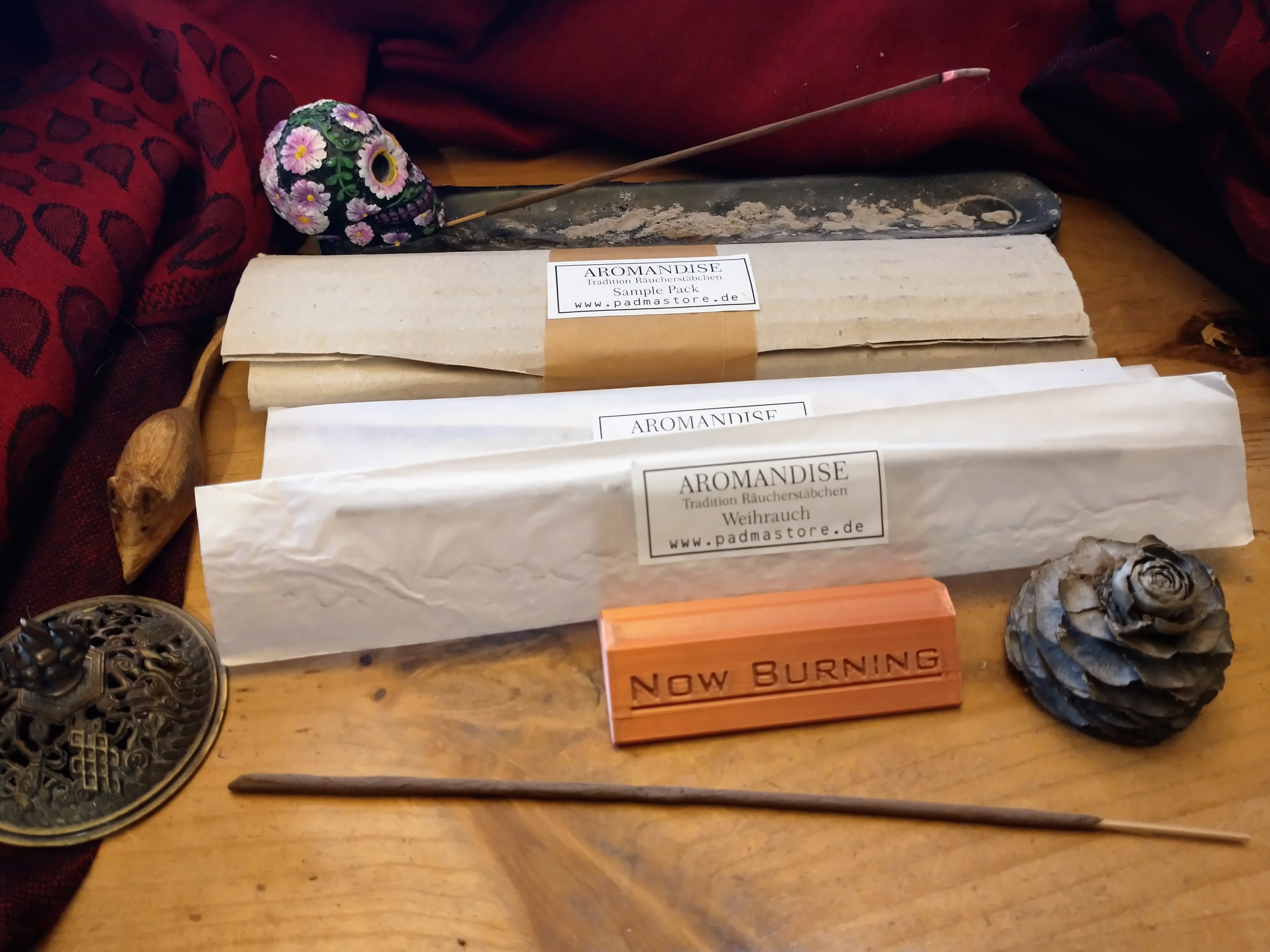
Naturveda (Aromandise - Les Encens du Monde) Haute Tradition Supreme Sandalwood


Supreme is a wonderful word, it feels rich and creamy - much more rounded, exotic, and tasty than premium, which is such an over-exploited term it now feels like flat cardboard in the mouth. Yet, they mean the same thing. It's a marketing term. But it looks and sounds so nice, especially when coupled with Sandalwood. "Supreme Sandalwood" sounds great. 

This is the last of the batch of Aromandise samples I got from Padma Store. And I'm pleased I've got to the end, as I have not really got on with them. They are OK incense sticks. Pure and natural. But they have been simply and crudely made, following the example of The Mother, Mirra Alfassa, who, in 1949, set up incense making in the Pondicherry area, insisting that it be pure and simple and low cost. No frills. And mostly basic mono-scents. The result is that most of the incense made in the Pondicherry area is dry, simple, sombre, somewhat harsh and peppery, with little awareness of either fun or olfactory knowledge. They may also be following the local Tamil Nadu tradition of using the residue left over from distilling resins and plants as a way of saving money. The result is a harsh, peppery scent when the incense is burned, but the locals like it that way.   


The paste is soft and crumbly, and is finished with a fine whitish powder.  There is a gentle and pleasant perfume on the stick - a little soapy, a little sweet, a modest white sandalwood rather like Chinese incense. The scent on the burn is like cheaper Asian wood based incenses. A basic woody sandalwood missing the dark, sultry oils. Light, modestly sweet and floral, with plain wood notes bordering on smoky. It's not harsh or peppery. It's OK, but it's very plain and simple. It smells like a cheap basic woody incense. 

Available from Aromandise, or Padma Store, or other outlets. 


Date: March 2025    Score: 24/50
***

Naturveda

Sandalwood

Friday, 28 March 2025

Naturveda (Aromandise - Les Encens du Monde) Haute Tradition Imperial Frankincense


Made for the French shop Aromandise (who sell their own brand incense under the name Les Encens du Monde) by a Pondicherry based white label company called Naturveda who utilise the cottage industries in and around Pondicherry in southern India. The incense sticks use pure and natural ingredients, though are simple and unrefined, following the tradition set up by Mirra (The Mother) Alfassa in 1949 in which the incense made for the Pondicherry ashram would be pure, natural, basic, low cost, everyday incense. I've been told that incense makers in Tamil Nadu, where Pondicherry is, like to use residues from distillation of resins and spices - this is a cheaper substance, which can result in the incenses having a harsh and peppery smell, though it has become the local taste. The incenses from Naturveda do have a harsh, peppery smell, in line with other incenses made by the Pondicherry cottage industries.

Hand rolled from a masala style wood powder paste onto a crude hand cut bamboo splint. There is only a faint, slightly sweet, faintly lemony and floral, scent on the stick - the fragrance ingredients have been folded into the paste, and it appears that no additional scents have been applied to the exterior. 

The scent on the burn is, for me, one of the more successful of this Haute Tradition series. It is frankincense, with a pleasant resinous fragrance, and a touch of sweetness to give some counterpoint to the spice and dry wood. It is recognisably frankincense, and reasonably pleasant, though is a little too dry, woody, and peppery for my taste.   

Available from Aromandise, or Padma Store, or other outlets. 


Date: March 2025    Score: 28 
***

Naturveda

Thursday, 27 March 2025

Naturveda (Aromandise - Les Encens du Monde) Haute Tradition Oriental Vetiver


Vetiver is a fragrant grass similar to lemongrass. It's not the most common of incense ingredients as a solo scent - indeed, this is I believe the first vetiver incense I've reviewed.  I note that Auroshika, who, like Naturveda, are part of the Pondicherry cottage industries, also sell a vetiver. I wonder how different they are? 

There is a mild, slightly peppery aroma on the stick. My observation of Naturveda and other Pondicherry incense is that the sticks use a traditional masala method in which the fragrances are folded into the paste which is hand-rolled onto the bamboo splints, and no oils or fragrant powders are added externally (as in perfume-dipped and perfumed-masala style incenses). My understanding is perfume-dipped incense is easy to make and control - the blank sticks can be made in various local households (or bought in bulk from Vietnam), then brought to a central location where the perfume solution is made up and applied. Perfumed-masala adds a layer to the masala method by adding a fragrant powder to the outside of the masala stick, and sometimes a perfume solution is also added externally. This tends to be done to give the stick an immediate appeal, even before it is burned. Perfume-dipped has that immediate appeal, while traditional masala does not. So adding a scent to the finished masala stick makes commercial and aesthetic sense. Pondicherry incense tends to eschew applying an external scent. This would be in keeping with Mirra (The Mother) Alfassa's decision back in 1949 when she set up incense production in Pondicherry that the incense would be basic, low cost, everyday incense. It seems likely that incense production in and around  Pondicherry is still following the basic, simple, pure, natural, and low cost approach. 

     
Ingredients: Wood powders, vetiver powder,
resin, lavender and vetiver essential oil

The scent on the burn, as is common with other Pondicherry incense, is faint, dry, sombre, peppery, a bit harsh, with more of a scent of smouldering wood than of the intended fragrance. After recently burning a fair amount of Chinese and Japanese incense, who also use wood powders and are not bold with applying the main fragrance ingredients, I had attuned my mind and senses to being patient and respectful and attentive to the subtle fragrance, and playing down my focus on the smouldering wood. I have been using that approach to these Naturveda sticks, though I do find it wearisome. I prefer to be a little more casual and relaxed with my incense.  I expect the incense, on the whole, to be doing the work, while I simply appreciate and enjoy the benefits. I am willing to concentrate now and again (as I tend to do anyway when reviewing), but if I do, then I want something special to reward my concentration. This Vetiver does have lemon notes - not clear and sharp, more like lemon soap, along with tree bark, and something vague and earthy. It all feels very ordinary and basic, not worth concentrating on. Sigh. 

Available from Aromandise, or Padma Store, or other outlets. 


Date: March 2025    Score: 24/50 
***

Naturveda

Monday, 24 March 2025

Naturveda (Aromandise - Les Encens du Monde) Haute Tradition Oriental Musk


Musk is an animal product, and can still be bought - but it is expensive: 12ml Siberian musk - £1,000. For financial and ethical reasons, hardly any perfume company has used animal musk for years. I don't know for sure, but given that alternative or synthetic musk is widely used, reasonably priced, and very good, I doubt if any incense company uses real musk. Naturveda use the plant labdanum, which is commonly used as an amber substitute, plus ylang-ylang, which is generally used to give floral and/or oriental notes.  That sounds quite promising.  However, my experiences so far with Naturveda, who are based in Pondicherry, and are the company responsible for putting together these incense sticks for the French shop Aromandise, has not been positive. Indeed, my experiences with all incenses made in and around Pondicherry (such as Cottage and One Aromatics) have not been positive. I tend to find them to be dry, peppery, old fashioned, and boring. I regard them as brown twigs. I don't find them to be awful - they are decent, well made incenses with a focus on being as natural as possible - just that they are not my thing. I like sweeter, livelier, more colourful and modern scents and accords. Each to their own. Anyway. I'm curious as to how I'm going to respond, because from the ingredients this sounds like it should be my sort of thing. 

   
Ingredients: Wood powders, natural honey,
labdanum gum, Ylang-Ylang essential oil

Scent on the stick is a little muted. A bit of sandalwood. Little else. The traditional masala style of making incense is to enfold the fragrance ingredients (dry and wet) in the paste before rolling out. This tends to result in a low aroma on the stick (unless scents have later been added to the outside of the stick either with oils or a fragrant melnoorva/masala powder). 

Scent on the burn is pretty much in the same field as the others in this range. It's dry and woody. It's kind of savoury. I think mostly of cedarwood. It's OK, but it doesn't excite or please me. 


Available from Aromandise, or Padma Store, or other outlets. 


Date: March 2025    Score: 25 
***

Naturveda


Naturveda (Aromandise - Les Encens du Monde) Haute Tradition Tender Patchouli


I've just been reviewing a bunch of Chinese incense I got via Temu. Like these sticks made in Pondicherry for the French shop Aromandise, Chinese incense uses wood powder as the combustible. I've struggled with wood as the combustible over the years, as I feel the scent of the burning wood intrudes. But burning the Chinese incense was fun, and it got me tuned into how to approach incense which uses wood as the combustible: give the incense some space - don't get too close. I've been doing that more and more over the years, but I am going to pay particular attention to doing that with wooden incense in future. 

In addition, I noted that I didn't get an allergic reaction as I burned the Chinese incense. I often get an irritation in my eyes, nose, or mouth when burning incense that has wood or wood resin, due to the terpenes in the wood. But that didn't happen with the Chinese incense. Perhaps that is an indicator that there is not much fragrant oil in the woods they use. I like heady incense, but I got attuned somewhat to the delicate and subtle nature of both the Chinese and the Japanese incense I've been exploring recently.  Pondicherry incense tends to have a soft scent, yet can still provoke a strong reaction. Is that due to the quality and purity of the oils used, rather than the amount? 

I like patchouli oil. I like it as a perfume on my body, and as an incense. It is one of the few fragrances where I am quite happy to have it as a single scent. I find patchouli rich, sexy, complex, and beautiful. So I am curious as to how I will respond to this Pondicherry made patchouli given that I tend to find Pondicherry made incense rather dry and boring. 

   
Ingredients: Wood powders, patchouli powder,
benzoin resin, patchouli essential oil

The scent on the stick is a temperate floral perfume with some peppery dry wood and a mild, cool volatility.  Scent on the burn follows pretty much the style and scent of other Pondicherry incense. Dry, sombre, peppery, woody. It's like a little bonfire of dry autumn leaves. It's a brown twiggy incense. I'm not getting the sweet, musky, sexy aspects of patchouli that I love, nor the fresh, green, minty florals. No. I've taken my experience with the Chinese incense, and kept my mind open, and my distance from the incense as it burns. But it hasn't worked. What dominates for me is the Pondicherry peppery brown twig scent.  

Available from Aromandise, or Padma Store, or other outlets. 


Date: March 2025    Score: 23/50 
***

Naturveda

Pick Some Perfect Patchouli

Sunday, 23 March 2025

Temu Sakura (Cherry Blossom) incense coil


A box of unbranded Chinese cherry blossom scented sandalwood coils from Temu for £1.71 for 20 coils. The quality of the Temu bought incense tends to range from budget everyday up to surprisingly decent, while the price is always very low. Temu's operational strategy is to send goods in bulk but in individual packets on which there is a convenience address in the destination territory, and using a convenience address in China, and this appears to avoid VAT and customs fees, thus keeping costs down. 

There is a light but very noticeable sweet fruit scent hovering around cherry. This is more of a cherry scent than a blossom scent. Sakura apparently smells of vanilla, and, yes, there may be some of that in here as well, along with delicate touches of white sandalwood.  It is a fairly bold fragrance for a Chinese incense from a thin coil. I like it. I'd be happy to burn this as an everyday room freshener because it projects so well, and delivers a delicate, uplifting, sweet scent. 


Date: March 2025   Score: 30/50
***


Temu "Thousand Year Old Agarwood" Floral Fragrance Agarwood incense coil


Oh gosh, this is lovely. Sweet, fruity, delicate, yet a strong enough scent to immediately grab the attention. And unlike much other Chinese incense, especially coils and small auspicious clouds, there are few wood scorching off notes when I get close. I love this. Honey and fermented sweet fruit and a gentle grounding of dark sultry wood. Definitely one of the best Chinese incense I've had so far. It smells more like a Japanese incense. From Temu: £2.52 for an attractive box of 48 coils with  stand included. I note that it is also available on Amazon, DH Gate, eBay, AliExpress, etc. A popular incense. 

There's a sort of mature, aged fruit vibe - fermented plums and figs warmed, and then covered in honey. Supporting that is a raspy, savoury, woody base note - a little wild. I'm not so keen on the wood as I am on the honeyed, aged, dark, juicy, alcoholic fruit. But overall I do like this. Quite a lot. 


Temu "Traditional Craft" Lavender incense coil


I've had four incense coils. They're a little fiddly to set up, and are best with a purpose built stand; though when I've mislaid my stand, I've made do with all manner of Heath Robinson contraptions. They always come with two spirals together, so the first thing you have to do is break them apart and untangle them. Easier said than done! I love the idea and look of them. Though I've not yet found a good one. Or, at least, one that I liked. They are generally sandalwood based, and I tend not to get on with wood based incense - though, as I've been exploring a lot of Chinese and Japanese incense recently, which are both very wood based, I have been learning how to burn and appreciate wood based incense. I find it helps not to get too close to the burning incense (this is generally true of most incense, though particularly so for wood based) as otherwise the smell of the burning wood will intrude on the intended scent - indeed, in many cases will not just intrude, but will dominate. So, light, and then place the incense at the far end of the room. Ensure there is some ventilation, but not too much. Relax and wait. 

There is an attractive image on the paper disc which is the cover of the circular plastic container. It's possibly an image of extruded incense being made, and left out to dry. Google Lens translates the text as Lavender and Traditional Craft. There is the faintest edge of a scent on the cool coil - like an old, dried up sliver of lavender soap, plus some dried apple, and old wool. The scent on the burn is really delicate (unless you get close, in which case it's a firmer scent of wood). The scent is soap, dried lavender, and a light fruit, some sweetness. It is there, and it is pleasant, though it has to be among the most delicate of incense scents I've experienced. I only notice it because I've decided to be positive about all Asian incense, as I think I've previously been too negative, and with a glass half empty attitude, so I have been too dismissive, and missed the point that Asian scents are not just wood based, but also very delicate. This is in marked contrast to Indian incenses, and those incenses which have been influenced by Indian. My world has been dominated by Indian incenses, so it has taken me a long while to get tuned into the quieter world of Asian incense. I much prefer the style of Indian incense, but I am working hard on understanding this quieter world of subtle, delicate incense. 

I suppose a culture produces and likes a style of incense that reflects themselves and their society. India is hot, colourful, noisy, bright, chatty and approachable. China is more ordered and quiet and polite. 

Anyway. I like the scent of this incense, and that it lingers pleasantly for at least 12 hours afterwards.  I like the coil shape. And I like that the incense is bringing me closer to the culture and traditions of China. But it is very faint. And if I get too close or too impatient what I get is scorched wood. I doubt that this is a quality incense in China. I suspect that this is an everyday incense. Possibly a budget incense. It's OK. It does it's job at a fair price. It's not an incense that is rocking my world, but I could see myself setting up five or six of these on coil stands around a large room to give gentle wafts of light, fruity lavender, and to be visually interesting. I think that would be cool when having guests round. 


Date: March 2025   Score: 25/50
***